
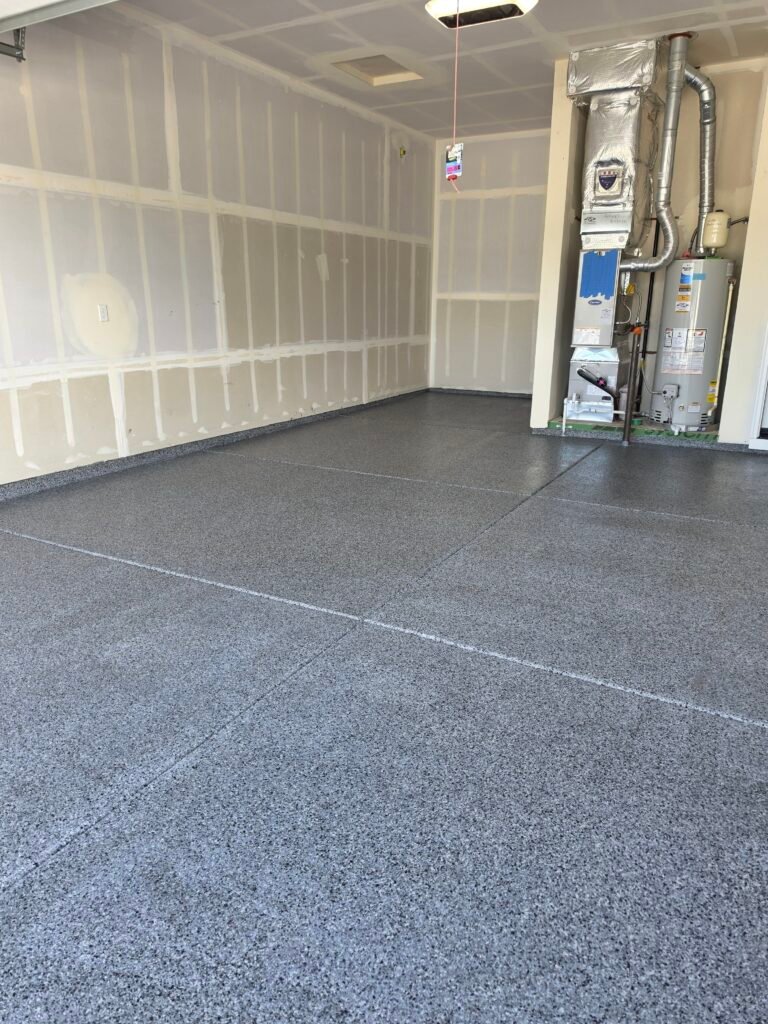
A garage floor peeling a few months after install is one of the worst feelings in home improvement — you paid real money, and now the floor looks worse than bare concrete. The good news: the answer is almost never a mystery. Epoxy doesn’t just decide to let go. When it peels, something underneath it went wrong: the prep, the moisture, the product, or the cure. Here’s how to read it, and whether it’s a spot fix or a full redo.
The four reasons epoxy peels
- The prep was skipped or done wrong. This is the big one, and it’s behind most peeling floors. If the concrete wasn’t mechanically ground, the coating has nothing to grip onto. Acid etching alone, or a quick pressure wash, leaves a smooth, dusty, or previously sealed surface — and the coating sits on top of it instead of bonding into it. When a floor peels off in sheets, that’s prep. A coating needs open concrete pores to bite into, and only diamond grinding opens them.
- Moisture pushing up from below. Concrete breathes, and in parts of the Treasure Valley that breath carries moisture vapor. When vapor pressure builds under a coating that wasn’t rated for the slab’s moisture, you get bubbles and blisters first, then peeling. This is why a real moisture test comes before any coating decision — a calcium chloride or relative-humidity test tells you what the slab is doing. No test means the system was a guess.
- Hot-tire pickup. Cheap coatings soften under hot tires in summer. The tire cools, sticks, and pulls the coating right off the slab when you back out. Easy to spot: perfect tire-shaped patches missing from the floor. A proper system with a polyaspartic topcoat resists it, because the topcoat stays hard and chemically resistant under heat. If your floor is peeling exactly where the tires sit, that’s the first suspect — and the fix is a better topcoat, not more of the same weak product.
- Thin or cheap product. DIY kits and bargain single-coat systems are a fraction of the thickness of a professional system. Thin coatings have no body to absorb movement, and in Idaho that matters: freeze-thaw cracks rigid, brittle coatings, and standard epoxy yellows under UV at the garage door opening. A thin coat over a moving slab is a countdown, not a floor.
Spot fix or full redo?
This is the question that decides your bill, so be honest about what you’re seeing.
A spot fix can work when the peeling is limited to a small area — an edge, a corner, one tire patch — and the rest of the floor is solidly bonded. Tap and tug at the coating around the failed spot — if it holds firm everywhere else, the failed area can be ground back to sound coating, feathered, and recoated. But the reason it failed has to be fixed too, or it peels again in the same place.
It’s a full redo when the peeling is widespread, the coating comes off in sheets, or bubbles are showing up across the floor. At that point the bond has failed as a system, and patching it is throwing money at a floor that will keep letting go. The whole failed coating has to come off and the job started over with real prep. Coating over peeling material just repeats the failure.
What proper prep looks like
The short version: grind, test, repair, coat, cure.
Diamond grinding across the whole slab, edges included. A moisture test before the system is chosen — if moisture is high, the system spec changes before the coating goes down, not after it bubbles. Cracks get filled, pits and spalls get patched. Then the system goes on — our standard is a hybrid: a full-flake epoxy base with a polyaspartic topcoat, so the epoxy builds thickness and body and the topcoat gives chemical resistance, UV stability, and flexibility through freeze-thaw. Then it cures on a schedule — foot traffic and vehicles go back on when the system is ready, not the moment it looks dry. A safe rule for driving on a new floor is 7 days, not 72 hours — rushing cure is how a good install gets its first damage.
What to ask before you hire again
If your floor failed once, the next quote has to answer four questions:
- Do you mechanically grind the whole slab, edges included?
- Do you moisture-test before choosing the system?
- What’s the full system spec — base, flake, topcoat — not just “epoxy”?
- What’s the warranty, and what does it actually cover?
If a quote can’t answer those, the price gap usually explains itself — it’s the prep being skipped.
What a good floor costs
A professionally installed garage floor in Boise runs $6–10 per square foot all-in — a standard two-car garage around $2,600–$4,400, $1,500 minimum. A properly prepped floor lasts 15–20 years. Run your garage through our garage floor cost calculator for a ballpark, or get a free estimate — we’ll test the slab and tell you straight whether it’s a spot fix or a redo.
Get a real read on your floor: call (986) 273-5409 for a free 15-minute estimate with a moisture check. Learn more on our garage floor epoxy page.
Boise Epoxy Flooring Co. LLC — licensed and insured, Treasure Valley local, 18 years in the trades. Epoxy and polyaspartic garage floors, concrete coatings, and outdoor structures.