
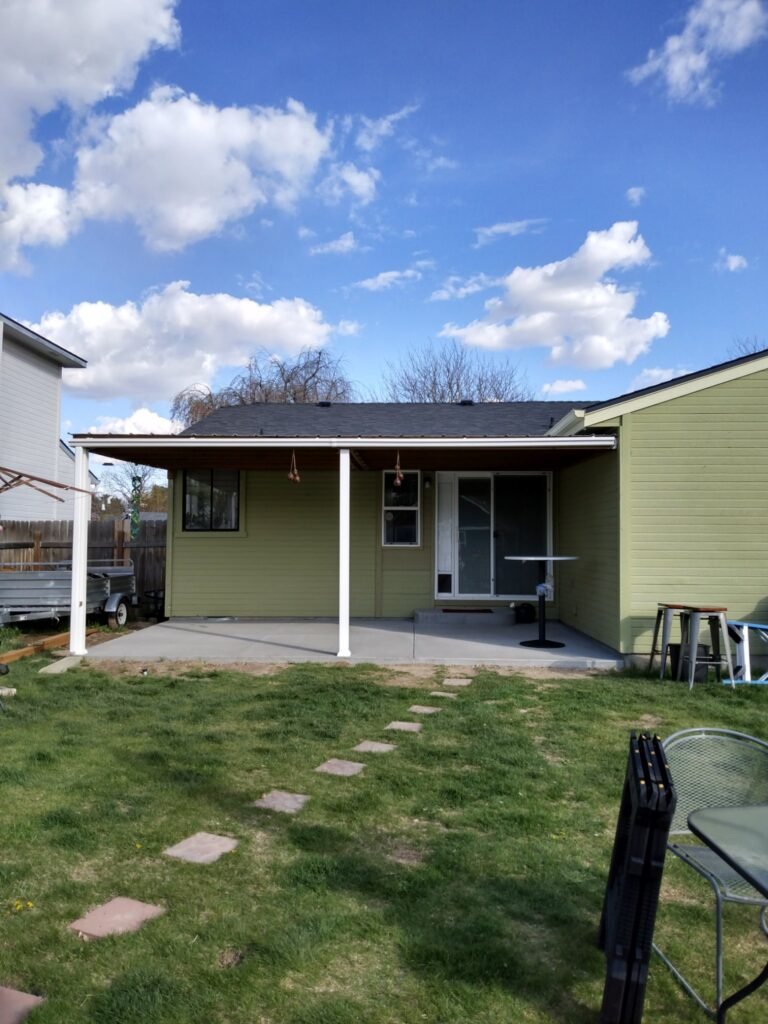
Every November the same question comes up: will this patio cover hold snow? It’s a fair question in Idaho. Some covers will and some won’t — and the difference is decided before the first snowflake falls, in the framing and the permit, not in the weather. Pergolas and patio covers collapse under snow every winter somewhere in the country. Here’s how to tell whether yours will make it through, and what a properly built cover looks like.
What snow load actually means
Snow load is measured in pounds per square foot (psf) — how much weight a roof has to carry. Building code (IRC R301.2.3) requires snow-load design anywhere the ground snow load exceeds 15 psf, and the required design load varies by location, from around 20 psf in milder areas up to 70 psf in heavy-snow country. The number that matters for your cover is the design load where you live, and the permit process is what sets it — a cover built to the local code load is engineered for the snow your area actually gets.
The problem is that a lot of what’s sold as a pergola or patio cover isn’t built to any load at all. Cheap pergola kits are commonly rated around 12 psf — below what code requires in most of Idaho. Louvered roof systems do better, typically rated 30–80 psf depending on the model, but only when they’re installed to the manufacturer’s spec.
Why covers fail
When a cover comes down in snow, it’s almost always one of four things.
Low pitch. Snow sheds off a sloped roof and sits on a flat one. A cover with too little pitch holds every inch of a storm until the weight wins. Our patio covers are built at a 2:12 pitch — enough slope for snow to slide and water to drain, instead of ponding and loading the frame.
Undersized beams. A beam that’s too small for its span sags under load, and once it sags, snow ponds in the low spot and the load gets worse. Doubled beams, proper post spacing, and spans sized to the load are what keep a cover straight through a heavy winter.
Weak connections. This is the failure in the collapse photos: a cross beam held by a single screw, a ledger nailed instead of bolted, a post sitting on a patio slab instead of a footing. Connections are where a cover lives or dies. Every rafter needs a real tie or hanger, the ledger needs proper bolts into the house, and posts need footings below frost line — not a few screws into trim.
No permit, no engineering. A cover built without a permit was never checked against the local snow load. That doesn’t mean it will fail, but it means nobody verified that it won’t. In the Treasure Valley, a patio cover is a permitted structure, and the permit is what forces the load question to be answered before the build, not after the first big snow.
What a properly built cover looks like
A cover that will hold snow has a few things you can check from the ground. Real pitch — at least 2:12 — so snow and water move off instead of sitting. Doubled beams and rafters sized to the span, not the cheapest lumber that fits. Hardware at every connection: hangers, ties, and bolts, not nails and hope. Posts on concrete footings, not sitting on the patio. A ledger properly flashed and bolted to the house, so water doesn’t get behind it and rot the connection from the inside. And a permit, which means the design load was checked against local code.
Louvered covers deserve a special note. Louvers give you shade control in summer, but in a snowstorm they need to be open — closed louvers catch snow like a solid roof. If you have a louvered system, open it before a storm, or make sure it’s rated for your area’s design load with the louvers closed.
If you already have a cover
Look at the connections — if you see a beam held by one screw, or a post that wobbles, that’s a fix before winter, not after. Clear heavy snow off the cover with a roof rake from the ground; don’t climb on it. And if your cover was built without a permit and you’re not sure what load it was designed for, get someone to look at it. A half-hour inspection is a lot cheaper than a collapsed cover on your patio furniture.
What a cover like this costs
Our patio covers run $28–50 per square foot, with a $4,500 minimum — that covers a permitted, engineered structure with proper pitch, framing, and hardware, not a kit bolted together in a weekend. We cover the numbers in detail in our post on patio cover cost in Boise and Nampa.
If you’re wondering whether your cover will make it through the winter, or you’re thinking about building one that will, call Boise Epoxy Flooring Co. at (986) 273-5409. Free estimates across Boise, Meridian, Nampa, Eagle, Star, Kuna, Caldwell, and Garden City. See everything we build on our outdoor structures page.
Boise Epoxy Flooring Co. LLC — licensed and insured, Treasure Valley local, 18 years in the trades. Epoxy and polyaspartic garage floors, concrete coatings, and outdoor structures.