Here’s the question that gets 23,000 upvotes on Reddit every time someone posts it: a pro quoted $4,000 or $6,000 to epoxy a garage floor, and the kit at the hardware store is $150. Is the pro ripping you off, or is the kit lying to you?
Neither, exactly. They’re two different products, two different processes, and two different results. The gap in price is real, and so is the gap in what you get.
What the kit actually is
A hardware-store epoxy kit is usually a water-based epoxy — sometimes so thin and so low in solids that it’s closer to paint than to a floor coating. The kit comes with an etching solution (usually a mild acid), the epoxy itself, some decorative chips, and instructions that make the whole thing sound like a weekend project.
And for a light-use space, it can work. A garage that’s really a storage room, a workshop where no car parks, a basement floor that just needs to look better — a kit, applied carefully, can look good for a couple of years.
Prep is the job — and the kit skips most of it
Here’s the thing every flooring pro will tell you, and it’s the thing that decides whether any coating lasts: the coating is only as good as its bond to the slab. A floor doesn’t usually wear out. It comes off.
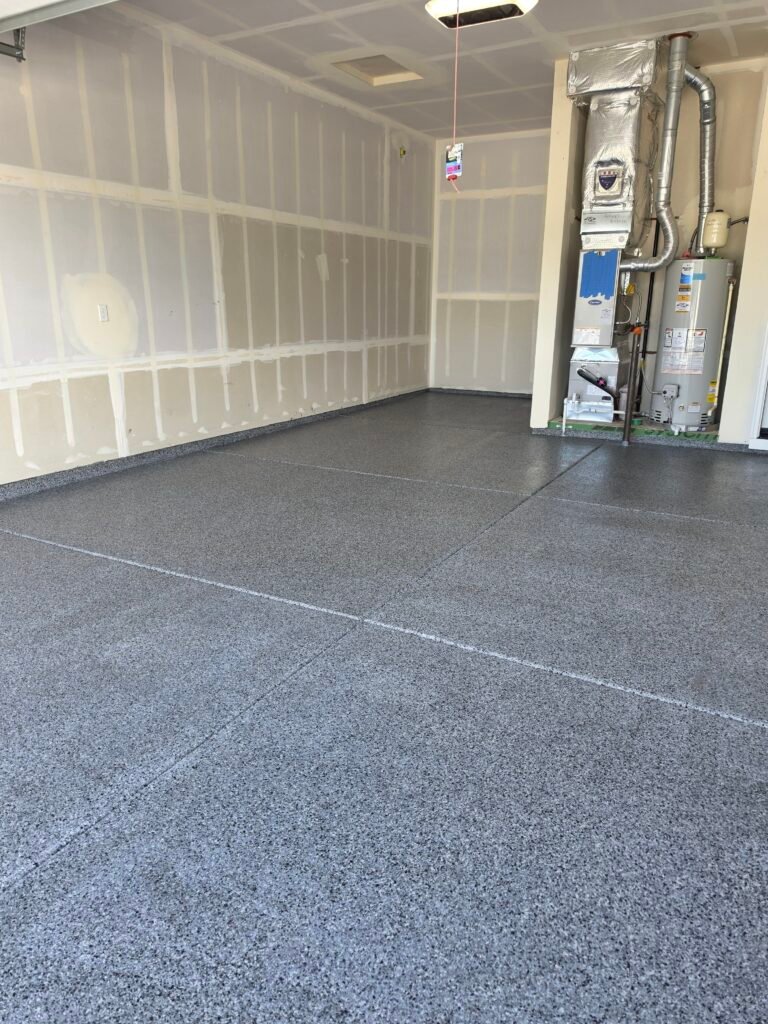
A professional install starts with mechanical grinding — a diamond grinder that opens up the concrete surface so the coating can bite into it. Then a moisture test to check whether vapor is coming up through the slab. Then the coating system itself: usually a 100%-solids epoxy base coat, a full broadcast of decorative chips, and a clear topcoat — often polyaspartic — that’s actually rated for hot tires and UV.
A kit install starts with acid etching — a chemical wash that’s supposed to rough up the surface — and then the coating goes on. Acid etching is better than nothing, but it’s not grinding. On a smooth, power-troweled garage slab — which is what most Treasure Valley homes have — acid etching doesn’t open the surface enough for a thin water-based product to grab onto. The result is a coating that’s sitting on the slab, not bonded to it.
The numbers, side by side
DIY kit: roughly $100–$1,000 all-in, depending on how many kits the garage takes and whether you buy a better topcoat. A standard 2-car garage usually takes two to four kits. Add a grinder rental and a moisture test kit if you’re doing it right, and you’re closer to $500–$1,000.
Professional install: a 2-car garage in the Treasure Valley typically runs $1,200–$3,800 from local installers, and our epoxy runs $6–10 per square foot with a $1,500 minimum. The $4,000–$6,000 quotes you see online are usually for larger garages or premium systems (metallic, polyaspartic topcoat).
So the real gap on a standard 2-car garage is more like $500 DIY vs. $2,000–$3,000 pro — not $150 vs. $6,000. Still a real gap. But the pro price includes the grinder, the moisture test, the solids content, the topcoat, the warranty, and the labor to do it in a day instead of a weekend.
Why DIY floors peel
When a DIY epoxy floor fails, it’s almost always one of these:
- No grinding. The number one cause. Smooth concrete plus a thin coating equals a coating that lets go. We’ve redone floors where the old DIY coating peeled off in sheets — you could lift it with a putty knife. The concrete underneath was perfectly smooth, because nothing had ever opened it up.
- Moisture from below. Concrete wicks moisture vapor up from the ground. If the slab has real moisture drive and nobody tested for it, the vapor pushes the coating off from underneath. This is the failure that shows up as bubbles and blisters, usually in the first year.
- Hot-tire pickup. Tires get hot driving, and hot rubber on a soft coating bonds to the coating better than the coating bonds to the concrete. Park the car, let the tires cool, back out — and a patch of coating comes with the tire. Cheap water-based epoxies are the most vulnerable to this.
- Cold install. Epoxy needs the slab at about 55°F or warmer to cure properly. Below that, the chemical reaction stalls and the coating never fully hardens — it stays soft, dents easily, and bonds weakly. In Idaho, that means a winter garage install needs the space heated for 24 to 48 hours before the work starts, long enough for the concrete itself to warm up, not just the air.
- Thin product. A water-based kit might be 40–50% solids, which means half of what you roll on evaporates as it dries. What’s left is a thin film. A 100%-solids epoxy stays where you put it.
When a kit is fine
Be honest about what the floor has to do. A kit is a reasonable choice when the space is light-use — storage, a workshop, a home gym, a basement — no car parks on it, and you’re willing to prep properly: rent the grinder, do the moisture test, and follow the recoat windows. Accept that it might last three to five years instead of ten to twenty, and you’re fine redoing it.
A kit is a bad choice when the floor takes a car every day, when the slab has moisture issues, when it’s a winter install in an unheated garage, or when you want the floor to last and you don’t want to do it twice.
What a pro install actually buys
It’s not just a thicker product. It’s the grinder, the moisture test, the right product for the slab temperature, the topcoat that handles hot tires, the warranty that means something, and the experience of knowing what a failing slab looks like before the coating goes on. The $2,000–$3,000 you pay a pro on a 2-car garage is mostly labor and prep — the coating itself is the smaller part of the bill.
And if a DIY floor peels — which is common — the redo costs more than the original pro job would have, because now the old coating has to come off first.
The bottom line
A $150 kit and a $3,000 pro install aren’t the same product at different prices. They’re different products, different prep, different durability. The kit is fine for a light-use floor if you prep it right.
Run your numbers on our garage floor cost calculator, and if you want a straight quote for your garage, call (986) 273-5409. We’ll come look at the slab free, test the moisture, and tell you what it needs — whether that’s our system or an honest “a kit will do fine here.” We’ll tell you that too.
Boise Epoxy Flooring Co. (BEFCO), based in Nampa. 18 years in the trades. Epoxy and polyaspartic garage floors, concrete coatings — and Boise Home Flooring, the interior division, for LVP, tile, and hardwood.