
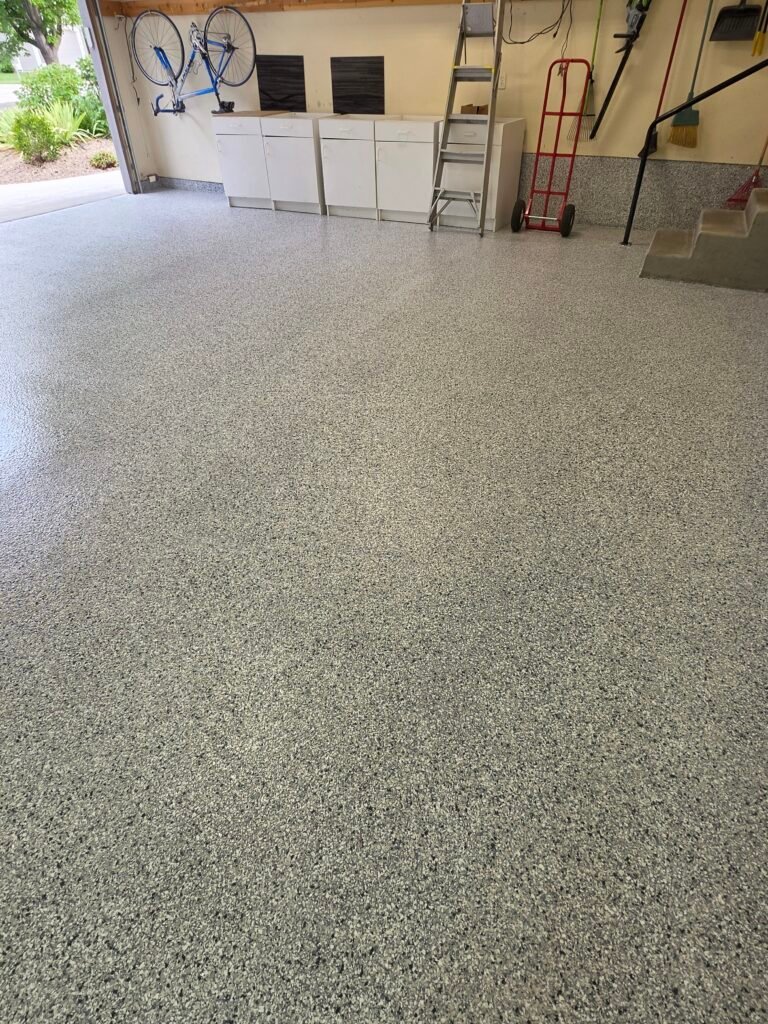
“Epoxy or polyaspartic?” is the question we get most from Boise homeowners pricing a garage floor, and the honest answer is that it’s not really either/or. The two materials are good at different parts of the job — which is why, for most garages we do, we recommend a hybrid: a full-flake epoxy base with a polyaspartic topcoat. You get epoxy’s bond and build where it matters, and polyaspartic’s speed and UV resistance on top. Here’s the head-to-head so you can see why.
The quick numbers
A professionally installed full-flake system in the Treasure Valley runs $6–$10 per square foot, all-in — diamond grinding, crack repair, full broadcast flake, and topcoat. A typical 2-car garage lands around $2,600–$4,400, with a $1,500 minimum on smaller floors. A polyaspartic-heavy system generally costs a bit more than an all-epoxy one; the hybrid sits in between. Installed right, any of these is a 15–20 year floor.
What each system costs, side by side
| System | Installed cost per sq ft | Cure / back in service | Best for |
|---|---|---|---|
| All-epoxy | $3–$8 (market range) | Slowest — full cure schedule, cold concrete stretches it out | Budget builds, shops with little sun |
| Hybrid: epoxy base + polyaspartic topcoat | $6–$10 — our price, all-in | 2-day install, vehicles back on a 7-day cure schedule | Most Boise garages — our standard recommendation |
| All-polyaspartic | $6–$12 (market range) | Fastest — often 1-day installs, cures in cold weather | Cold-weather installs, maximum UV stability |
A standard two-car garage on our hybrid system runs around $2,600–$4,400, with a $1,500 minimum on smaller floors. The spread in the market columns is real: the low end of all-epoxy is thin, single-coat work, and the high end of polyaspartic is a full build with premium materials. The hybrid sits in the middle because it uses each material where it’s best — epoxy for bond and build underneath, polyaspartic for cure speed, UV stability, and hot-tire resistance on top. That’s why it’s our standard system. If you want your exact number, the calculator on this site will get you a ballpark, and a free estimate gets you a written price.
Cure time
Epoxy is the slow one. A traditional epoxy base needs real cure time before it can be recoated or walked on hard, and cold concrete stretches that out. Polyaspartic cures fast — that’s its headline feature — and a polyaspartic topcoat is a big reason our standard install runs 2 days total instead of three or four. Faster cure also means a bigger margin for error for the installer, though: polyaspartic gives you a short working window, and a crew that isn’t practiced with it can leave roller marks that never come out.
UV stability
This is epoxy’s real weakness. Left exposed to sunlight, epoxy yellows over time — walk any older all-epoxy garage with the door open to the south and you’ll see the amber band where the sun hits. Polyaspartic is UV-stable and doesn’t yellow, which is exactly why it belongs on top, where the sun actually reaches. Under a topcoat, the epoxy base never sees UV, so the weakness never comes into play.
Hot-tire pickup
Hot tires off summer asphalt can soften and lift a coating that isn’t up to it — the classic failure is a tire-shaped peel. Lower-grade epoxies and thin DIY kits are the usual victims. A properly ground, properly built full-flake system with a quality polyaspartic topcoat resists hot-tire pickup well; this is one of the places the professional prep and material thickness pay for themselves.
Temperature windows
Epoxy likes moderate temperatures and gets sluggish — or won’t cure right — on cold concrete. Polyaspartic applies and cures in a much wider temperature range, which matters in the Treasure Valley: we install through Boise winters and summers, and the hybrid system gives us workable windows in January garages and July garages alike. It’s also part of why installs here have to be scheduled around the actual slab temperature, not just the forecast.
What Boise garages actually throw at a floor
Winter here means road salt and mag chloride tracked in on every tire, freeze-thaw swings, and meltwater sitting on the slab. Summer means a garage that can bake all afternoon. A full-flake hybrid handles both ends: the flake broadcast adds texture and hides the wear, the topcoat shrugs off salt and chemicals, and the whole system hoses out clean in the spring. A bargain single-coat system of either material is what struggles — the material debate matters less than prep and thickness, every time.
So which one should you pick?
- All-epoxy: fine for a budget build or a shop that sees little sun — accept slower cure and keep UV exposure in mind.
- All-polyaspartic: fast and UV-stable, at a higher material cost and with less working time during install.
- Hybrid (our recommendation for most garages): epoxy base for bond and build, polyaspartic topcoat for cure speed, UV stability, and hot-tire resistance. Best of both, at a mid-range price.
Get your exact number
Run your garage size through our garage floor cost calculator for a ballpark, then let us look at the actual slab — estimates are free, take about 15 minutes, and include a moisture check and a written price. Call Boise Epoxy Flooring Co. at (986) 273-5409 or request a quote through the site. We install across Boise, Meridian, Nampa, Eagle, Star, Kuna, and Caldwell.
Boise Epoxy Flooring Co. LLC (BEFCO) — licensed and insured, Treasure Valley local, 18 years in the trades. Garage floors, shop coatings, and commercial epoxy.
Pingback: How Long Does an Epoxy Garage Floor Last in Idaho? - Boise Epoxy Flooring Co
Pingback: Can You Coat a Garage Floor in Winter in Idaho? - Boise Epoxy Flooring Co
Pingback: DIY Epoxy Kit vs Pro Install: Honest Math