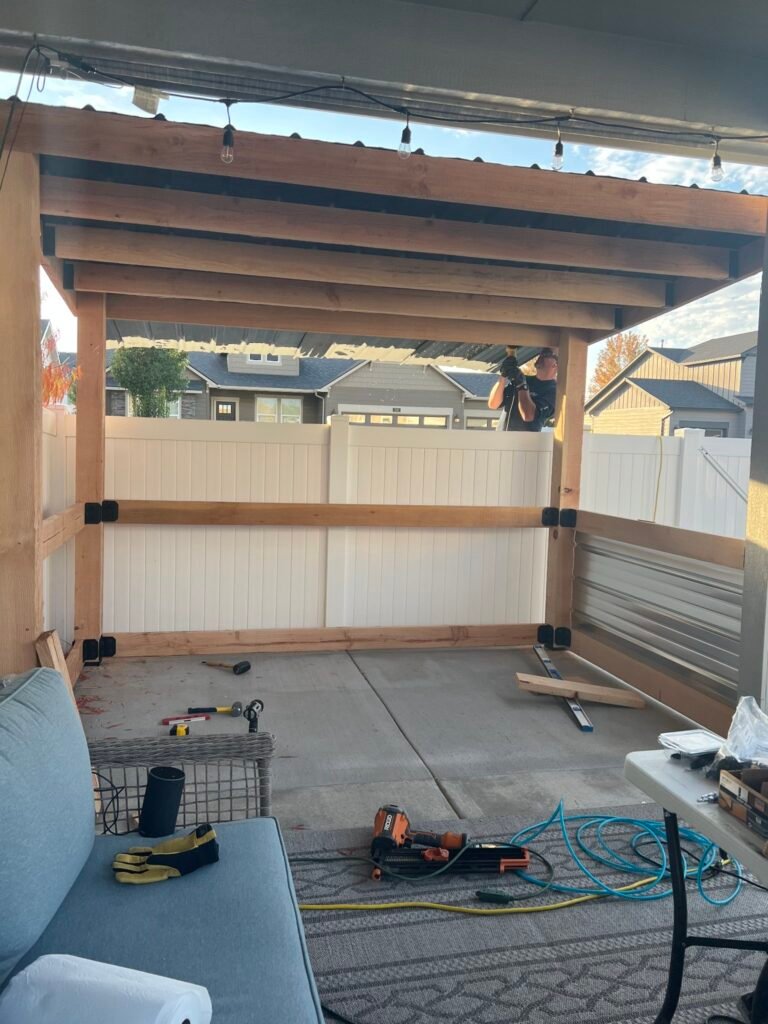
A pergola is the outdoor structure people ask about when they want shade and a defined outdoor space but don’t want a full solid roof. It’s an open structure — posts, beams, and rafters or slats overhead — that gives you partial shade, a frame for climbing plants or string lights, and a backyard that feels like a room instead of a yard.
The price range is wide, and that’s the first thing to understand. A small pergola can cost a few thousand dollars. A large one with a louvered roof can cost as much as a car.
The size ranges
These are typical installed ranges for a professionally built pergola in the Treasure Valley — not kit prices, not DIY material costs, but the whole job done:
- 10×10 pergola: roughly $1,500–$4,000
- 12×16 pergola: roughly $3,000–$6,500
- 16×20 and larger: roughly $6,000–$12,000 and up
Those ranges are wide because pergolas vary more than almost any other outdoor structure. A basic pressure-treated wood pergola with a simple slat top is at the bottom. A cedar pergola with decorative end cuts, a stain finish, and a privacy wall is in the middle. A powder-coated aluminum pergola with a motorized louvered roof — one that opens and closes — starts around $20,000 and can run $30,000 to $80,000 installed depending on size and brand. That louvered tier is a different product from a wood pergola, and it should be quoted as one.
With us, pergolas are quoted per project — the size, material, and site conditions move the number too much for a flat per-square-foot rate. Patio covers, for comparison, run $28–50 per square foot with a $4,500 minimum.
What drives the price
Size. More square feet means more posts, more beams, more rafters, more footings. This is the biggest single driver and the most obvious one.
Material. Pressure-treated pine is the cheapest. Cedar costs more and looks better. Powder-coated aluminum costs the most of the standard options but needs no maintenance and won’t warp or check. Vinyl exists but doesn’t hold up well to our sun and temperature swings — we don’t recommend it here.
Footings. Every post needs a footing, and footings are the least glamorous and most expensive part of the job per unit. A typical footing runs around $300 each installed — dug below the frost line, formed, inspected, and poured. A four-post pergola has four footings. When a bid seems too cheap, the first thing to check is whether the footings are in it at all.
Roof type. Open slats are the baseline. A solid roof turns a pergola into a patio cover — different product, different price, and honestly a better one if what you actually want is rain protection. A louvered roof that opens and closes is the premium option: great product when it’s done right, but the motorized systems add thousands and the installation has to be exact.
Permits. Permit fees typically add $200–$600 on top of the build cost, and they’re often excluded from low bids. A pergola that’s attached to the house nearly always needs a permit. A freestanding pergola under 200 square feet sometimes doesn’t, depending on height and setbacks — but “sometimes” is doing a lot of work there, and the setback rules still apply either way. We handle the permit as part of the job and it’s a line item in the quote, not a surprise.
Site conditions. Flat ground with easy access is cheap. A sloped lot, a tight backyard with no equipment access, or a patio that needs to be cut for footings all add cost.
What’s usually missing from low bids
Pergola quotes in the Treasure Valley commonly come in $3,000–$5,000 apart for the same structure, and the gap is almost always what’s missing, not what’s included. Before you compare two numbers, check that both include:
- Footings — real concrete footings, inspected, not deck blocks
- Permit fees — and who’s pulling the permit
- Stain or finish — raw wood left unstained will gray out in one Idaho summer
- Haul-off — old concrete, old lumber, dirt from the footing holes
- Hardware — brackets, bolts, and fasteners rated for outdoor use, not the cheapest box at the hardware store
A bid that’s missing two of those isn’t cheaper. It’s incomplete.
The louvered pergola caution
Motorized louvered pergolas — the ones with aluminum slats that tilt open and closed — are popular right now, and the big national brands charge a premium for them. There’s a real caution here that doesn’t show up in the brochures: some of these systems are sold through dealers, and there are documented cases of homeowners paying large deposits — $10,000 in one case — and the dealer disappearing before the install, or the install running six months past an eight-week promise with no refund. That’s not a reason to avoid louvered pergolas. It’s a reason to know exactly who you’re buying from and what the deposit terms are. With a local builder, that question has a simple answer.
There’s also a practical note: aluminum louvers can drum in heavy rain and wind — a vibration noise that makes conversation underneath difficult. It’s worth hearing one in the rain before you commit, if you can.
Pergola vs. patio cover: which do you actually want?
This is the question that saves people money. A pergola gives you partial shade and an open feel. It does not keep rain off you, it does not keep snow off your furniture, and it doesn’t extend your patio season the way a solid roof does. If what you want is a dry place to sit outside in April and October, a patio cover is the better buy — and the price overlap between a high-end pergola and a basic patio cover is real.
Pick a pergola if you want the look — the open sky, the light coming through the slats, the frame for plants and lights — and you’re honest with yourself that shade, not shelter, is what you’re buying. Pick a patio cover if you want to actually use the space when it’s raining.
The bottom line
A pergola costs what it costs because of size, material, footings, and roof type — and the cheapest quote is usually the one that’s missing the footings and the permit.
Get a real number for your yard
Call (986) 273-5409 and we’ll come look free anywhere in Boise, Nampa, Meridian, Eagle, Star, Kuna, Caldwell, Middleton, and Garden City. We’ll talk through pergola vs. patio cover for your yard, check the site and the setbacks, and give you a written price — footings, permit, and finish included.
Boise Epoxy Flooring Co. (BEFCO), based in Nampa. 18 years in the trades. Pergolas, patio covers, decks, carports, epoxy floors — and Boise Home Flooring, the interior division, for LVP, tile, and hardwood.