
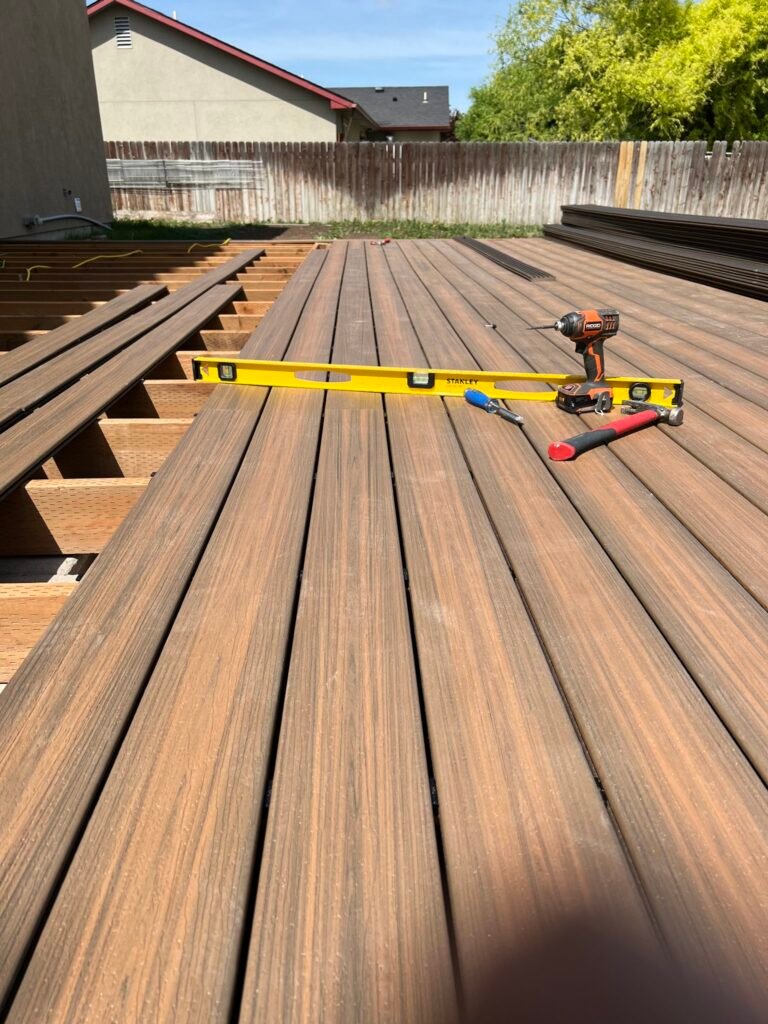
If you’ve gotten two deck quotes and they were thousands of dollars apart, you’re not going crazy — you probably got one quote for pressure-treated wood and one for composite, and nobody explained the difference. Or you got two quotes for the same material and they still didn’t match, which happens too. Here’s the straight version of how these two materials compare, what they actually cost around here, and which one fits which homeowner.
What they cost — the real numbers
Pressure-treated (PT) pine is the baseline. Installed, a PT deck runs about $30 per square foot all-in with us — framing, decking, fasteners, and a standard rail. That’s the number to hold in your head.
Composite decking starts around $45 per square foot installed and goes up from there depending on the board. Premium capped composite with hidden fasteners can push past $60 a foot. So on a 300-square-foot deck, you’re looking at roughly $9,000 for PT versus $13,500 and up for composite — a $4,500-plus gap on the same deck.
That gap is why quotes don’t cluster. A homeowner who hears $22,000 for a plain 320-square-foot composite deck and $89,000 for a 12-by-16 from another builder isn’t hearing two prices for the same job — they’re hearing different materials, different framing, different rails, different stairs, and sometimes just different levels of honesty about what’s included. Always ask what’s in the number: framing, footings, stairs, rail, permits, and haul-off. A low bid that’s missing the permit or the stairs isn’t low — it’s incomplete.
Maintenance: the real cost of wood
This is where the math gets honest. A PT deck is cheaper to build and more expensive to own. The wood needs to be cleaned and sealed or stained every two to three years in Idaho — our sun is hard on it in the summer and the freeze-thaw in the winter works on any crack in the finish. Skip the maintenance and a PT deck grays out, checks, splinters, and starts looking tired in five to seven years. Keep up with it and a PT deck lasts 15 to 20 years looking good.
Composite asks almost nothing of you. Hose it off, scrub it once a season. No staining, no sealing, no splinters. It fades a little in the first year and then holds its color — a 25- to 30-year deck with a fraction of the upkeep.
So the question isn’t really “which is cheaper” — it’s “do you want to pay now or pay over time, in money and in weekends?” If you like maintaining things and you like the look and feel of real wood, PT is a fine deck and the lower upfront cost is real. If you’d rather never think about your deck again after it’s built, composite earns its premium.
How they hold up in Idaho
Idaho is not gentle on decks. Summer sun bakes the surface, winter freeze-thaw cycles work on every joint, and road salt and snowmelt find their way onto anything near a driveway or walkway.
PT handles all of that fine as long as the finish is maintained — the treatment protects against rot and insects, and the wood itself is forgiving. The weak point is the surface: unsealed PT checks and cracks, and once water gets into those checks and freezes, it opens them further. That’s a maintenance problem, not a material problem.
Composite doesn’t rot, doesn’t splinter, and doesn’t need sealing. Its weak points are different: it gets hotter underfoot in direct sun than wood does — noticeably hotter on a July afternoon — and it can scratch and stain from dragged furniture or a dropped grill. Most composite also needs tighter joist spacing than wood, which brings us to the framing.
The framing nobody talks about
Here’s the detail that decides whether a composite deck feels solid or feels like a trampoline: composite boards aren’t as stiff as lumber. They need more support underneath — typically joists at 12 inches on center instead of 16 — or they’ll sag between joists over time, especially on a hot day when the boards soften slightly.
That extra framing costs money: more joists, more hangers, more labor. It’s part of why composite costs more per square foot, and it’s the first thing a low composite bid skips. A composite deck framed at 16 inches on center will look fine on day one and feel wrong by year two. If you’re comparing composite quotes, ask about joist spacing. It’s the fastest way to tell who’s building it right.
PT, being stiffer, is fine on standard 16-inch spacing. That’s one more reason the PT number comes in lower.
What about cedar?
Cedar sits between the two on price and has a look a lot of people love — warm, natural, smells good the first year. It needs the same maintenance as PT (cleaning and sealing), it’s softer so it dents and scratches more easily, and in our climate it doesn’t outlast PT by enough to justify the premium for most people.
Which one should you pick?
Pick pressure-treated if: budget matters most right now, you like the look and feel of real wood, you don’t mind staining it every couple of years, and the deck is mostly shaded or covered.
Pick composite if: you want to stop thinking about maintenance, the deck is in full sun, you have kids or bare feet (no splinters), and you’re planning to stay in the house long enough for the low maintenance to pay you back.
Pick a covered deck either way if you can: a patio cover or a roof over part of the deck does more for the life of any decking material than any product choice. Shade and rain protection slow down everything that ages a deck. We build covers and decks together for exactly that reason.
The bottom line
There’s no wrong answer here — there’s a wrong answer for your situation. A PT deck at $30 a square foot is a great deck if you’ll maintain it. A composite deck from $45 a square foot is a great deck if you want to forget about it. What you don’t want is a composite deck framed like a wood deck, or a PT deck nobody ever seals. Either way, the material is only half the job — the framing and the finish are the other half, and they’re the half that decides how the deck feels in five years.
Get a real number for your yard
Call (986) 273-5409 and we’ll come measure free anywhere in Boise, Nampa, Meridian, Eagle, Star, Kuna, Caldwell, Middleton, and Garden City. We’ll price it both ways — PT and composite — so you can see the actual gap for your deck instead of guessing from two quotes that might not even be for the same thing.
Boise Epoxy Flooring Co. (BEFCO), based in Nampa. 18 years in the trades. Decks, patio covers, carports, pergolas, epoxy floors — and Boise Home Flooring, the interior division, for LVP, tile, and hardwood.