
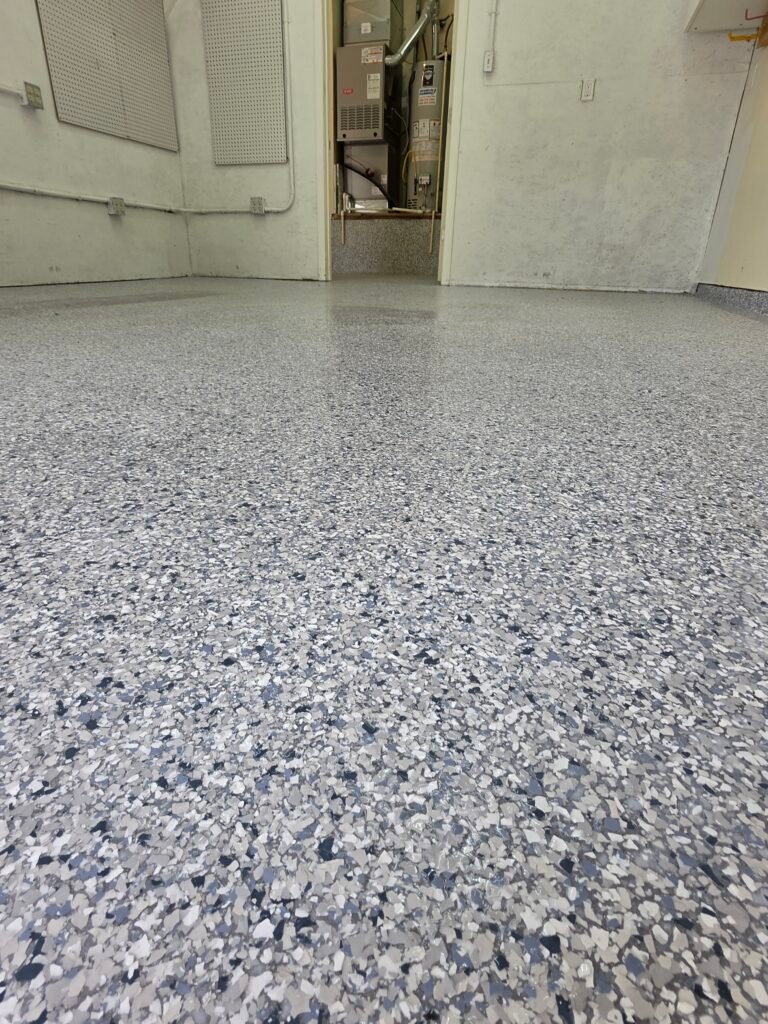
Short answer: yes, if the system is right. The question isn’t really “can you coat in winter” — it’s “can this material cure on a cold slab.” Standard epoxy gets sluggish on cold concrete and may not cure right at all. Polyaspartic cures in a much wider temperature range, which is why winter installs are realistic with a hybrid system: epoxy base for bond and build, polyaspartic topcoat for cure speed and UV stability.
Slab temperature, not air temperature
This is the part most people miss. A garage can feel fine at noon while the slab is still cold from an overnight freeze. We schedule around the actual slab temperature, not just the forecast — that’s what decides whether a coat goes down that day. A January garage and a July garage get different install windows, and a crew that ignores that is how you get a coating that never fully bonds.
Why winter is actually a decent time to do it
Winter is when your garage floor takes its worst beating — road salt, mag chloride, meltwater sitting on bare concrete. Coating before or during winter means the salt lands on a topcoat that shrugs it off instead of soaking into raw concrete. And winter scheduling is usually easier: fewer people are booking, so lead times are shorter than the spring rush.
What a winter install looks like
Same system, same prep: diamond grinding, crack repair, moisture check, full-flake broadcast, polyaspartic topcoat. Our standard install runs 2 days total, and the polyaspartic topcoat is a big reason it’s two days instead of three or four — fast cure means the garage is back in service sooner. One honest caveat: polyaspartic gives the installer a short working window, so the crew has to be practiced with it, or you’ll see roller marks that never come out.
For what happens when that prep is skipped, see why garage floor coatings fail in Idaho.
What it costs
Same pricing year-round: $6–$10 per square foot all-in for a full-flake system, $1,500 minimum, typical 2-car garage around $2,600–$4,400. Run your size through our garage floor cost calculator for a ballpark, or read the full epoxy vs. polyaspartic comparison if you’re weighing systems.
FAQ
Can epoxy be installed in cold weather? Standard epoxy struggles on cold concrete. Polyaspartic and hybrid systems cure in a much wider temperature range, which is what makes Idaho winter installs workable.
Does the garage need to be heated during install? Not necessarily — what matters is the slab temperature at install time. We check the slab itself and schedule around it.
Is winter harder on a new coating? No — once cured, the system is built for exactly this: salt, meltwater, and freeze-thaw. Winter is what it protects against.
How long before I can park on it? With a polyaspartic topcoat, cure is fast — most garages are back in service much sooner than an all-epoxy install. We’ll give you the exact window at install.
Estimates are free, take about 15 minutes, and include a moisture check and a written price. Call Boise Epoxy Flooring Co. at (986) 273-5409 or request a quote through the site. We install across Boise, Meridian, Nampa, Eagle, Star, Kuna, and Caldwell — winters included.
Boise Epoxy Flooring Co. LLC (BEFCO) — licensed and insured, Treasure Valley local, 18 years in the trades.
Pingback: Why Garage Floor Coatings Fail in Idaho (and What Proper Prep Looks Like) - Boise Epoxy Flooring Co