
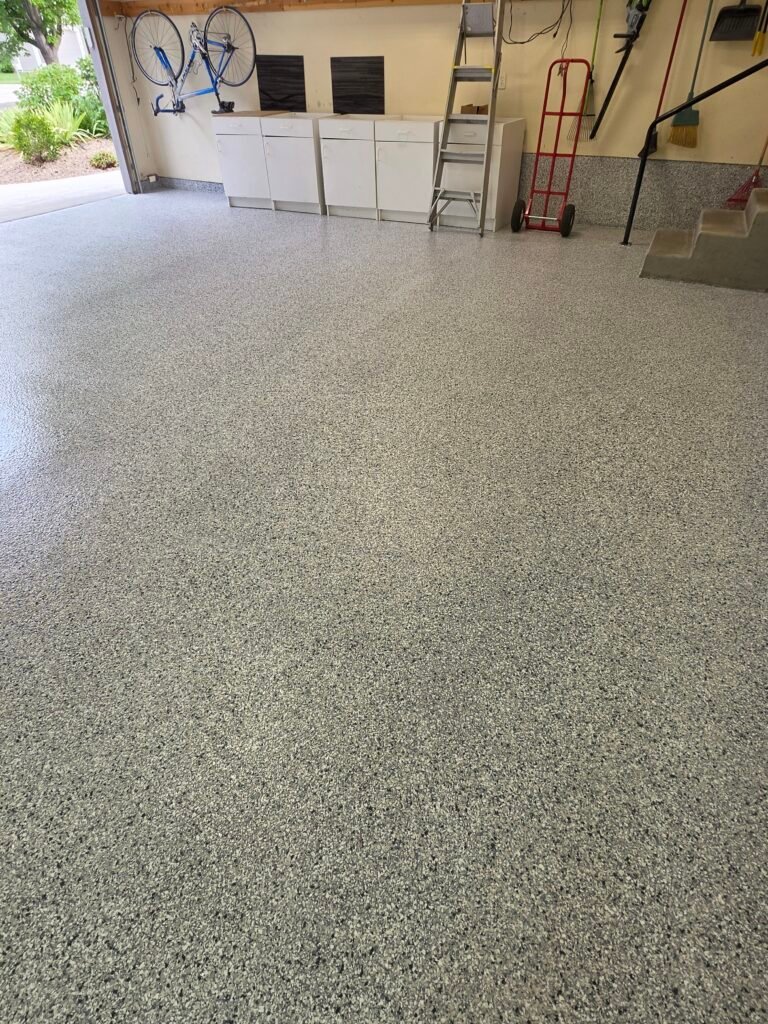
Ask ten contractors how long an epoxy garage floor lasts and you’ll get ten answers, mostly because “epoxy floor” covers everything from a $200 DIY kit to a professionally ground full-flake system. In Idaho, with our freeze-thaw swings, road salt, and summer heat, the honest answer for a professionally installed floor is 15–20 years. Here’s what puts a floor on the long end of that range — and what kills one early.
Prep is the whole game
Most failed garage floors don’t fail because of the coating. They fail because of what’s underneath it. A floor that was acid-etched instead of diamond-ground, or coated over moisture pushing up through the slab, will peel no matter how good the product on top is. Professional prep means diamond grinding to open the concrete, crack repair, and a moisture check before anything goes down. That’s why our free estimates include a moisture check — it’s the test that decides whether the floor is ready, not just how big it is.
For the full breakdown of failure modes, see why garage floor coatings fail in Idaho.
The system matters more than the brand name
A single thin coat of epoxy is a different animal from a full-flake system: epoxy base, full broadcast flake, and a polyaspartic topcoat. The build thickness is what stands up to hot tires, dropped tools, and salt. The topcoat matters too — standard epoxy yellows in sunlight, which is why we put a UV-stable polyaspartic topcoat on top, where the sun actually reaches. We broke down the full comparison in our epoxy vs. polyaspartic guide.
What Idaho winters do to a floor
Winter is the real test. Road salt and mag chloride get tracked in on every tire, meltwater sits on the slab, and the concrete moves between cold snaps and warm afternoons. A properly built full-flake system shrugs that off and hoses clean in the spring. A bargain single-coat system is what lifts, usually starting at the tire paths.
Maintenance is almost nothing
Sweep the grit out, mop with water and a pH-neutral cleaner, rinse spills as they happen. That’s it. No resealing schedule, no special products. Grit is the one thing worth staying on top of — it’s sandpaper under tires over time.
What it costs, and what shortens it
A professionally installed full-flake system in the Treasure Valley runs $6–$10 per square foot, all-in, with a $1,500 minimum. A typical 2-car garage lands around $2,600–$4,400. Run your size through our garage floor cost calculator for a ballpark. The things that shorten a floor’s life are almost all avoidable: skipping prep, coating over moisture, a thin DIY kit, and no UV-stable topcoat on a sun-exposed slab.
FAQ
How long does an epoxy garage floor last in Boise? Professionally installed, 15–20 years. DIY kits and thin single coats typically last a few years before peeling, especially under hot tires and winter salt.
Does Idaho’s freeze-thaw cycle damage epoxy floors? Not a properly built one. The failure mode is a rigid, thin coating that can’t move with the slab. A full-flake system with a flexible polyaspartic topcoat moves with it instead of letting go.
Can you recoat an old epoxy floor? Usually, yes — if the existing coating is still bonded. It gets ground and recoated rather than torn out. If it’s already peeling widely, it needs to come off first.
Does an epoxy floor need resealing? No annual reseal. Sweep, mop, done. If the topcoat eventually wears thin after many years, a fresh topcoat refreshes it without redoing the whole floor.
Get your exact number: estimates are free, take about 15 minutes, and include a moisture check and a written price. Call Boise Epoxy Flooring Co. at (986) 273-5409 or request a quote through the site. We install across Boise, Meridian, Nampa, Eagle, Star, Kuna, and Caldwell.
Boise Epoxy Flooring Co. LLC (BEFCO) — licensed and insured, Treasure Valley local, 18 years in the trades.